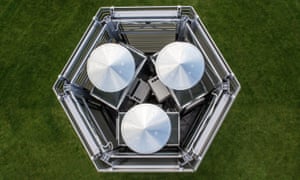
Almost as long as I’ve been covering green tech, the Block Island Wind Farm has been in the works. The project, first approved by the Rhode Island Public Utilities Commission in 2010, was seen as a smaller-scale pilot project that could prove the feasibility of offshore wind power generation in the U.S.
Six years later, it will be a 30-MW installation that will provide most of the power needs of Block Island, an island off Rhode Island that currently gets its electricity from diesel generators.
The project was initially planned for completion in 2012, but set backs and plan changes have delayed it. GE, the makers of the five 6-MW “Haliade” turbines that will make up the project, has just announced that the wind farm is on target to be up and running by the end of the year. Even with the delays, it will be the first completed offshore wind farm in the country.
The five wind turbines, each twice as tall as the Statue of Liberty and with a diameter of double the size of a 747 Jumbo jet wingspan, will be able to generate about 125,000 MWh of electricity, or enough to meet 90 percent of Block Island’s energy needs. They will be located three miles offshore of Block Island and underwater transmission cables will connect them to the island and mainland Rhode Island where excess energy will go to the grid.
SBG Cleantech Ltd, a joint venture between SoftBank Group Corp., India’s Bharti Enterprises Ltd and Taiwan-based Foxconn Technology Group, has bagged a 350-megawatt (MW) solar power project in Andhra Pradesh after it matched the record low bid seen in the previous round.
SBG Cleantech won the project, under the Jawaharlal Nehru National Solar Mission (NSM), at a bid of Rs.4.63 per kilowatt-hour (kWh), according to people familiar with the bids.
India’s solar power tariff touched a record-low of Rs.4.63 last month when US-based SunEdison Inc. won a 500MW tender put out by state-run NTPC Ltd in Andhra Pradesh under NSM. SBG Cleantech lost the project as it bid higher at Rs.4.80 per kWh.
This is the first renewable energy project that SBG Cleantech Ltd has won in India. The venture was set up in June after SoftBank Corp.’s Masayoshi Son pledged to invest least $20 billion in solar energy projects in India.
An email sent to SBG Cleantech was not immediately answered.
The entire 350MW capacity is meant for a single project inside the solar park developed by NTPC, which will also be the buyer of the power produced from the plant.
The auction which concluded late on Monday night also saw Yarrow Infrastructure Ltd, a part of IndiaBulls group, bid at Rs.4.64, while Azure Power India Pvt. Ltd bid at Rs.4.76 and Reliance CleanGen Ltd bid at Rs.4.88.
Other bidders, who quoted a tariff above Rs.5 per kWh included Goldman Sachs-backed ReNew Solar Power Pvt. Ltd, China’s Trina Solar’s unit Mira Zavas Pvt. Ltd, and Marikal Solar Parks Pvt. Ltd, a unit of American photovoltaic module maker First Solar Inc.
“SoftBank is surely establishing itself as a serious and competitive player in the market. The company is likely to be a strong contender in the upcoming national bids as well,” said Jasmeet Khurana, associate director—consulting at Bridge to India, a boutique consulting firm.
Recent bids show that there are only about 10 to 12 developers who have the appetite to continuously try and take up large projects at current tariff levels, Khurana said.
Some expect the upcoming auction at Rajasthan—to be held later this year for a capacity of 420MW—to see more aggressive bids.
Some industry experts, however, have raised concerns over the viability of projects won at aggressive tariffs.
“This raises questions on the long-term viability. The advantages these companies (SunEdison and SoftBank) had in these two bids is that the plants would be at solar parks so they do not have to worry about setting up everything on their own. Also, NTPC is more bankable than any other state distribution companies,” said Bharat Bhushan Agrawal, senior analyst—India solar at Bloomberg New Energy Finance.
SunEdison, the world’s largest renewable energy company, is also increasing focus on India, its second largest market after the US. China’s Trina Solar and Russia’s OAO Rosneft, Italy’s Enel Green Power are among other global companies looking to invest in the Indian solar market.
India has raised its 2022 solar energy target to 100 gigawatts (GW) from 20GW as part of the Narendra Modi-led National Democratic Alliance (NDA) government’s efforts to lower dependence on coal-fuelled electricity.
India has a $250 billion investment opportunity in the renewable energy sector, Piyush Goyal, minister for power, coal and renewable energy, said at Mint’s fifth energy conclave in New Delhi in September.
The smog-free tower in Rotterdam sucks in dirty air, filters it and returns bubbles of clean air through its vents.
Photograph: PimHendriksen.com/Studio Roosegaarde
The Dutch city of Rotterdam has opened the world’s first smog-free tower.
Co-designed by Dutch artist Daan Roosegaarde, the seven-metre high tower sucks in dirty air like a giant vacuum cleaner. Ion technology then filters it, before returning bubbles of smog-free air through the tower’s vents. It is able to clean 30,000 cubic metres of air an hour, according to Roosegaarde.
Clean air is a precious commodity. A new study has found that more than three million people die prematurely due to air pollution each year. This is projected to double by 2050 if the problem isn’t tackled.
“The smog-free tower contributes to a debate that shouldn’t be confined to politics,” says Rotterdam’s mayor, Ahmed Aboutaleb. “Air pollution is a matter that affects us all, and it requires a serious discussion. But we do need innovators like Daan Roosegaarde to start the conversation at another level.”
Roosegaarde has far-reaching ambitions for the tower, which is part of his Smog-Free Project. “It’s not only intended to be a local solution that creates clean parks or playgrounds,” he explains. “It’s also a sensory experience of a clean future, a place where people can experience clean air.”
He hopes to bring together governments, NGOs, the clean tech industry and ordinary citizens. “We can work together to make whole cities smog-free,” he says. “We can wait – or we can participate.”
The man behind the tower’s Hoover-like cleaning filter is Bob Ursem, a nanoparticles expert at the Delft University of Technology. In outdoor tests, the filter has cleaned the air by 60%, measured by the share of nanoparticles removed, and in indoor environments the reduction is even more significant, he claims. “We’ve installed it in a parking garage here in the Netherlands and it sucks and cleans both the inside and outside air,” Ursem says. “Inside the parking garage, the air became 70% cleaner.”
An aerial view of the smog free tower. Photograph: Studio Roosegaarde
But it’s not Rotterdam where the need for air filters is greatest. According to the World Air Quality Index, most of western Europe enjoys clean air, with exceptions including London, where air quality is classified as moderate. It’s a different story in the booming cities of the developing world and the Bric countries. Air quality is much poorer in China and Malaysia, for example, where most cities feature air deemed unhealthy for sensitive groups. The air in several cities, including Delhi, has been classified as very unhealthy, indicating emergency conditions.
Earlier this month, Chinese authorities shut hundreds of factories in Beijing and banned half of the country’s 5m cars from the roads in preparation for a gigantic military parade. In the days leading up to the parade, the air quality improved, resulting in pristine blue skies for the parade, only to return to smog when the ban was lifted.
According to Ursem, Rotterdam’s filter can easily be scaled to help alleviate Beijing’s smog. Yet while smog filters may offer some hope to suffering residents of booming cities, as the military parade ban suggests, no one technology or tactic can be as effective as working on the root causes of air pollution. In the tower’s case, the filters would be costly too . While neither Roosegaarde nor Ursem would disclose the cost of the tower, the filters they have developed range in price from €1,600 to more than €118,000.
Aboutaleb acknowledges the innovation’s limitations: “It may not be the answer to all our problems, but this shouldn’t be the main objective,” he says. “The objective must lie in a different perspective, a refreshing approach to a global problem.”
Esben Alslund-Lanthén, a researcher at the Danish sustainability thinktank Sustainia, says the filter is not a large-scale environmental solution but can be useful as an awareness-building: “It shows how polluted our cities are, especially from energy and transportation”.
A person who has inhaled the tower’s healthy air may find it a shock to return to the more polluted city air outside the clean bubble.
“Whether the air filter is scalable or not depends not just on its technical viability, but on whether city governments are good at learning from each other to bring about change,” argues Sascha Haselmayer, founder and CEO of Citymart, a firm that connects urban innovation projects with cities.
Some local politicians seem keen to encourage clean air-thoughts among their residents, perhaps hoping that it will make them more amenable to restrictions on fuel and dirty energy. New York City, Ursem reports, has just ordered 12 street-cleaning cars featuring the air filter. There will be a pilot air-filter project in Eindhoven, and Ursem’s team is in negotiations for a similar project in Paris.
“Fallout Shelter” is becoming a sensation, which is why Bethesda isn’t wasting any time in improving the mobile simulation game. Apart from much-needed changes, its first update introduces the new Photo Mode feature, which allows players to take a screenshot of their vault.
To capture that special “Fallout Shelter” moment with those adorable vault dwellers, gamers simply need to tap the button at the bottom left corner of the screen. They can save the photo on the device or share it with their friends via their social media accounts.
The update also fixes a bug that badger pregnant dwellers.
“Vault air filters have been causing some mothers to not deliver babies and we understand this is causing long term discomfort,” Bethesda said.
With the update, all that’s taken care of. The game studio quipped that they can’t do much about the actual “discomfort [with] the baby coming out part.” Nevertheless, it’s good to know that pregnant dwellers will actually give birth this time.
And lastly, the update should eliminate minor issues and bugs, which makes the game more stable now. Here is what Bethesda promises with the first ever update for “Fallout Shelter”:
Overseers are encouraged to record any bizarre dweller behavior with the new Photo Feature. Sharing with those outside your Vault is optional, and will not result in your replacement or termination.
Vault air filters have been causing some mothers to not deliver babies and we understand this is causing long term discomfort. We have solved this (not the discomfort, the baby coming out part).
We’ve also done general maintenance to improve sudden Vault shut down and removed some other pesky issues with the capacitors inside various aspects of the simulation.
Those who have yet to experience the free game can head over here and get started with building a state-of-the-art underground vault.
The takeoff of Solar Impulse 2 will cap 13 years of research and testing by Swiss pilots
TAKE FLIGHT. Solar-powered plane Solar Impulse 2 takes off during a test flight in Abu Dhabi on March 2, 2015. Photo by Agence France-Presse
ABU DHABI, United Arab Emirates – The first attempt to fly around the world in a plane using solar energy will be launched Monday, March 9, in Abu Dhabi, its pilots said, in a landmark journey aimed at promoting green energy.
The takeoff of Solar Impulse 2, which was delayed on Saturday due to high winds, would cap 13 years of research and testing by Swiss pilots Andre Borschberg and Bertrand Piccard.
“This project is a human project, it is a human challenge,” Borschberg, co-founder and chief executive of Solar Impulse who will fly the plane on the first leg, told reporters on Sunday.
The wingspan of the one-seater plane, known as the Si2, is slightly bigger than that of a jumbo jet, but its weight is around that of a family car.
It will take off from Abu Dhabi on Monday at 6:30 am (0230 GMT), landing first in Muscat, Oman.
From there, it will make 12 stops on an epic journey spread over 5 months, with a total flight time of around 25 days.
It will cross the Arabian Sea to India before heading on to Myanmar, China, Hawaii and New York.
Landings are also earmarked for the midwestern United States and either southern Europe or North Africa, depending on weather conditions.
The longest single leg will see a lone pilot fly non-stop for 5 days across the Pacific Ocean between Nanjing, China and Hawaii, a distance of 8,500 kilometers (5,270 miles).
Borschberg and Piccard will alternate turns at the controls because the plane can hold only one person.
All this will happen without burning a drop of fuel.
“We want to share our vision of a clean future,” said Piccard, chairman of Solar Impulse.
“Climate change is a fantastic opportunity to bring in the market new green technologies that save energy, save natural resources of our planet, make profit, create jobs, and sustain growth.”
The pilots’ idea was ridiculed by the aviation industry when it was first unveiled.
But Piccard, who hails from a family of scientist-adventurers and was the first person, in 1999, to circumnavigate the globe in a hot air balloon, clung to his belief that clean technology and renewable energy “can achieve the impossible.”
The plane is powered by more than 17,000 solar cells built into wings that, at 72 metres (236 feet), are longer than a jumbo and approaching that of an Airbus A380 superjumbo.
Clean energy petition
Thanks to an innovative design, the lightweight carbon fiber aircraft weighs only 2.3 tonnes, about the same as a family 4X4 and less than one percent of the weight of the A380.
The Si2 is the first solar-powered aircraft able to stay aloft for several days and nights.
The propellor craft has 4 17.5 horsepower electric motors with rechargeable lithium batteries.
It will travel at 50-100 kilometers per hour, with the slower speeds at night to prevent the batteries from draining too quickly.
The Si2 is the successor to Solar Impulse, a smaller craft that notched up a 26-hour flight in 2010, proving its ability to store enough power in the batteries during the day to keep flying at night
It made its last successful test flight in the United Arab Emirates on March 2, and mission chiefs reported no problems.
It is scheduled to arrive back in Abu Dhabi in July, flown by Piccard.
For him, “the project should not finish in July, it should start in July.” A petition was launched on futureisclean.org to campaign in favor of clean energy.
The pilots will be linked to a control center in Monaco where 65 weathermen, air traffic controllers and engineers will be stationed. A team of 65 support staff will travel with the two pilots.
Its progress can be monitored via live video streaming at www.solarimpulse.com. – Wissam Keyrouz, AFP/Rappler.com
FEBRUARY 15, 2015 — Norway’s Havyard Ship Technology AS reports that its Leirvik shipyard has delivered the first of three Havard 8302 SV wind farm service vessels to Danish shipowner Esvagt.
The vessel is the first of a pair ordered in July 2013 to work under long-term contracts with Siemens on service assignments for offshore wind farms. The second is scheduled for delivery from the shipyard in March this year. Esvagt has also ordered an additional Havyard 832 SOV from the shipbuilder that will be under contract for the Dudgeon windfarm, which is operated by Statoil.
“This is yet another milestone for Havyard,” says Kenneth Pettersen, head of the Ship Technology business area in Havyard Group ASA.”Havyard has good references and a strong position in designing, building and fitting out advanced vessels for use in connection with offshore oil production. We have now used this expertise and experience to gain a foothold in the new and exciting renewable energy segment. We also design and build vessels for the fisheries and aquaculture industries, and we have orders for several icebreaker vessels on our books.”
“In times with low oil prices and a weak market for the oil service companies, it is a strength that we have several strings to our bow,” he adds. “We will use our expertise to continue to explore opportunities in alternative markets.”
As with the other vessels built at the shipyard, the design and detailed engineering for production of the vessel are provide by Havyard Design & Solutions, with Havyard Power & Systems, which is based in Ålesund, delivering the electrical engineering, automation and alarm systems and Havyard ConceptBridge. Havyard Ship Technology now has fishing vessels, live fish carriers, offshore vessels, icebreakers and service vessels for wind farms under construction for shipping companies from Norway, Iceland, Denmark and Russia.
“Most companies in our industry are experiencing a challenging situation because of the low oil price, a reduced activity level and cost-cutting by the oil companies,” says Gisle Vinjevoll Thrane, who is Senior Vice President Sales at Havyard Design & Solutions AS. “However, we also see many opportunities in other markets, not just in the offshore industry. The low exchange rate for the Norwegian krone is also an advantage for us, and we are now finding that we can compete with countries that we have previously regarded as low-cost countries. This is a golden opportunity for foreign shipping companies, or shipping companies whose revenues are in foreign currency, to build in Norway.”
In addition to designs for the building of ships at Havyard’s own yard, Havyard Design & Solutions also has orders for the delivery of design and equipment packages for the building of ships of Havyard design in Brazil, Spain, Singapore, India and China.
HAVYARD 832 SOV
The primary task of the Havyard 832 SOV vessels will be to provide accommodations and transportation for personnel and equipment involved in service and maintenance of offshore wind turbines.
The ship is equipped with a specialized gangway system that makes it possible to transfer personnel to the wind turbines in harsh weather conditions.
Emphasis has been placed on providing good facilities and comfort for the personnel on board, the ability to stay in position by the wind turbines, and environmentally friendly and economical transit between onshore bases and the offshore wind farms offshore.
The Havyard 832 SOV has a foreship designed to have good properties in both calm and rough seas and a stern with twin skegs that improve the performance of the hull and propellers and their operating economy.
Length: 83.7 m Breadth: 17.6 m Speed: 14 knots Accommodations: 60 persons
Shares of solar and renewable-energy companies were gaining sharply on Monday, in sympathy with higher conventional-energy stocks. If one sector is sensitive to market fall and lower crude oil prices, it is the alternative energy sector — including solar energy. As the price of crude oil gains, the demand for alternative forms of energy becomes much stronger. This is why oil and solar stocks, for example, often trade similarly. Analysts in recent years have debated whether alternative energy stocks are directly correlated to the price of crude oil. Some contend that pricier oil pushes renewable energy companies higher, as investors and consumers search for cheaper alternatives to fossil fuels.
Yingli Green Energy Hold. Co. Ltd. (ADR) (NYSE:YGE), Trina Solar Limited (ADR) (NYSE:TSL), First Solar, Inc. (NASDAQ:FSLR) and SunPower Corporation (NASDAQ:SPWR) all were among noteworthy gainers.
Crude oil prices rose on Monday as investors shrugged off a U.S. refinery strike and focused on a falling U.S. rig count that signaled lower production down the line.
“There were a lot of people on the sidelines waiting for an opportunity to buy,” said Bjarne Schieldrop, chief commodity analyst at SEB.
“Brent has struggled sideways for a long time but it closed above the 20-day moving average on Friday for the first time since July, and the rig count is falling sharply. So now they think, maybe this is the time to buy.”
Brent crude speculators raised their net long positions by 1,056 contracts to 143,039 in the week to Jan. 27, ICE said on Monday, as some investors took the view that the oil price was beginning to bottom out. [O/ICE]
Both contracts rallied about 8 percent on Friday, fuelled by month-end short-covering and a record weekly drop in the number of U.S. oil rigs employed, according to industry data from Baker Hughes. The count is down 24 percent from its October peak.
“Most market observers have been surprised by the scale of the decrease, and expectations of U.S. oil output this year will no doubt be lowered accordingly,” analysts at Commerzbank said in a note. “The foundation for a steady price recovery in the second half of the year has thus been laid.”
However, in the short term the price increase has been exaggerated as there is still considerable oversupply, they said.
In the United States, union workers were on strike for a second day on Monday at nine refineries and chemical plants as they sought a new national contract with oil companies covering labourers at 63 plants.
This boosted refined oil products prices in the United States and Europe, as traders anticipated more arbitrage opportunities opening up to the west.
“Values are following through to the upside this morning as U.S. product markets gather additional bullish momentum off of labour strikes at several U.S. refiners,” Jim Ritterbusch, president at Ritterbusch & Associates, said in a research note.
Norfolk, Va. – Dominion Virginia Power wants to build the first commercial solar energy plant in the state.
The company says it will save money in the long run, but first there will be a slight surge in customer bills.
If Dominion Power gets its way, a field of solar panels will be soaking up the sun in Northern Virginia by the end of 2016.
Dominion filed an application with the Virginia State Corporation Commission to build a $47 million solar energy plant in Fauquier County – the first in Virginia.
Dominion wants to temporarily raise customer’s bills by $.04 each month during construction and then drop $.02 per month once it’s built.
At peak capacity, the Remington Solar Power Plant could power 5,000 homes.
MHI Vestas Offshore Wind has received the first commercial order for the V164-8.0 MW from DONG Energy, the world’s leading developer of offshore wind power.
MHI Vestas Offshore Wind will deliver 32 machines for the 258 MW Burbo Bank Extension project off the coast of Liverpool Bay in the UK.
Blades for the project will be produced at the recently announced MHI Vestas Offshore Wind manufacturing facility on the Isle of Wight – the first facility with the capacity to serial produce blades for future UK offshore projects.
Milestone project CEO Jens Tommerup says the order marks a historic milestone for MHI Vestas Offshore Wind and the wind industry in the UK,
“We are extremely pleased to receive the first commercial order for the V164-8.0 MW, our flagship wind turbine and a machine which will contribute to driving down the cost of offshore wind energy.
“DONG Energy were closely involved in the development and testing of the turbine and today’s announcement represents a significant vote of confidence from the world’s leading developer of offshore wind in the V164-8.0 MW and MHI Vestas Offshore Wind.
“MHI Vestas Offshore Wind will become the first manufacturer with the capacity to serial produce blades for future offshore wind projects in the UK. Serial production of 80m blades for the Burbo Bank Extension project will commence on the Isle of Wight from as early as Q2 2015.”
Samuel Leupold, Executive Vice President in DONG Energy, said
“We are very excited to being able to construct the Burbo Bank Extension offshore wind farm. The introduction of the MHI Vestas Offshore Wind V164-8.0 MW turbine will be an important measure in our joint efforts to reduce the cost of electricity of offshore wind. Bigger turbines, producing electricity more efficiently is an important element in realising our ambitious targets.”
About the Burbo Bank project The 258 MW Burbo Bank Extension project lies off the coast of Liverpool Bay, in the UK. When installed the power plant will produce enough energy to meet the electricity requirements for approximately 180,000 houses.
The order includes supply, installation and commissioning of the wind turbines as well as a five year full scope service contract. Installation is expected to begin in 2016, and commissioning is expected to be completed in 2017. Pre-assembly of the turbines will take place in Belfast, Northern Ireland.
Manufacturing in the UK MHI Vestas Offshore Wind will utilise the production hall at Vestas’ blades technology centre on the Isle of Wight from 1 January 2015 and will invest in upgrading the facility for serial production. The facility was opened in 2011 and was specifically designed to develop large blades for the latest wind turbines. The facility consists of two halls 170m long and 50m wide, one for testing and verification, and one for blade production, which will be leased by MHI Vestas Offshore Wind.
Jens Tommerup said,
“The Isle of Wight is a world class R&D centre for developing and testing blades. The blades for the V164-8.0 MW prototype were designed, manufactured and tested at the Isle of Wight facility so we have developed the unique skills and processes necessary to manufacture blades which makes it a good location to ramp up to serial production.”
The 19.54 hectare solar energy park would generate enough electricity to power 2,500 homes
An Aberdeen-based renewable energy firm has submitted a planning application to create Scotland’s first solar energy park in Angus.
BWE Partnership is proposing a 19.54 hectare solar energy park at New Mains of Guynd Farm in Arbroath.
Under the plans, part of New Mains of Guynd Farm in Angus would be transformed into a solar energy park for a period of 25 years, after which the components would be removed.
The solar park proposal would operate with a capacity of 9.5 megawatts, which the developers say would provide enough electricity to power 2,500 homes.
Ron Shanks, managing partner of BWE Partnership, said: “We are pleased to have reached the planning application stage in the development process and hopefully our proposal will be viewed favourably by Angus Council and the local community.
“We continue to be on the look-out for further solar park opportunities, especially in Angus and Fife, as we believe there is a real opportunity for Scotland to harvest energy from the daylight.”
JLL provided planning and development advice on behalf of BWE Partnership.
Steven Black, Director of Planning and Development for JLL, said: “Whilst the idea of farming sunshine in Scotland may seem odd to some people, the lower intensity of sunlight is compensated for by longer hours of daylight, making solar power a viable resource of renewable energy north of the border.
“As one of the first developers to submit plans for such a site in Scotland, the park will provide a model for solar energy in rural areas.
“Not only will it help contribute to the UK and Scottish Government’s renewable energy targets, but it will bring significant investment into the local area, providing employment opportunities and supporting rural diversification.”
A significant obstacle to maximizing solar energy output is the accumulation of dirt and dust on the photovoltaic solar panels, which reduces output considerably. This is especially true for solar energy parks located in deserts. But cleaning the panels of a entire park may take days, during which the park works at a less than optimal level. The dirt and dust accumulated between cleaning cycles also need to be taken care of as the soiling could lead to a decrease in production levels.
Ecoppia, a privately-held, Israel-based company, has provided a solution to this problem. The company develops energy-independent E4 cleaning robots that use a soft microfiber and air flow cleaning system to remove 99 percent of dust daily and put zero load on the panel surface. The company has installed its robotic system at Ketura Sun Solar park, which is jointly owned by Siemens AG and Arava Power, located in Israel’s Negev desert. Ecoppia reports that the 8-hectare facility is serviced by nearly 100 E4 robots that clean the solar panels every night.
Instead of using water, Ecoppia’s centrally-controlled robot crew uses microfibers and controlled air flow to push the dirt off the panels.
“We conducted a thorough worldwide search for a cleaning solution that could deal with the challenging weather conditions in our solar parks. Only Ecoppia’s solution showed actual significant uplift in production, while offering an extremely appealing business model. We are proud to be their partners,” Arava Power CEO Jon Cohen was quoted as saying.
Siemens Energy has been awarded a major order by Minnesota Power for 64 units of the company’s latest 3-MW D3 platform wind turbines to be installed at the Bison Wind Energy Center near New Salem, North Dakota. The innovative wind turbines feature a 113-m rotor and 92.5-m hub height and thus increased rating of 3.2 MW. Turbine installation is scheduled to begin in mid-June 2014, and commercial operation is slated for December 2014. The scope of supply includes transportation, installation and commissioning, as well as a three-year service and maintenance agreement.
Capacity of Siemens‘ 3-MW D3 platform wind turbines increases to 3.2 MW thanks to larger rotors and higher towers.
“With our innovative 3-MW direct drive turbine we are increasing annual energy output with a larger rotor and a higher tower,” states Dr. Markus Tacke, CEO of Siemens Wind Power. “We greatly value Minnesota Power’s confidence in our technologies and services and are very pleased to partner with them once again as they continue to provide reliable, affordable and sustainable power to their customers.”
The blades will be manufactured at Siemens’ facility in Fort Madison, Iowa. Also, the D3 nacelle component will be assembled in Hutchinson, Kansas. Assembly of this specific major component was recently moved from the company’s nacelle facility in Brande, Denmark, to Hutchinson, Kansas, which further demonstrates the company’s commitment to the U.S. wind industry.
“We’re pleased to partner with a world leader like Siemens as wind energy production develops and matures,” said Minnesota Power Chief Operating Officer Brad Oachs. “With the help of Siemens, we’ve integrated new direct drive technology into our Bison project while at the same time staying ahead of Minnesota’s aggressive renewable energy standard.”
By 2025, utilities in Minnesota are required to supply 25% of their power from renewables. Operators of nuclear power plants have to reach 30% renewables even earlier by 2020.
The 205-MW Bison 4 addition will increase Minnesota Power’s Bison Wind Energy Center’s total MW output to nearly 500 MW. Siemens also supplied all of the wind turbines for the previous three phases of the Bison Wind Energy Center, which went into commercial operation in 2010 and 2012.
Wind power and energy service are part of Siemens’ Environmental Portfolio. Around 43 percent of its total revenue stems from green products and solutions. That makes Siemens one of the world’s leading providers of eco-friendly technology.
Siemens www.siemens.com
This entry passed through the Full-Text RSS service — if this is your content and you’re reading it on someone else’s site, please read the FAQ at fivefilters.org/content-only/faq.php#publishers.