Nikola Tesla Secret
Showing posts with label Investment. Show all posts

Monday, 15 February 2016

Pension funds put activism before investment returns


The divestment of various “undesirable” companies and industries held by government investment portfolios has been all the rage in recent years, but politicizing investment decisions is bad news for taxpayers.


The California State Teachers’ Retirement System voted this month to get rid of all of its stocks in U.S. coal companies, and the University of California system acceded in December to students’ demands to sell off about $30 million of its investments in companies that operate prisons.


Despite the latest divestment fads, such investment activism is hardly new. The California Public Employees’ Retirement System has prohibited investments in gun manufacturers, tobacco companies and any company that might compete with state or local employees for contracts. After CalPERS lost 9.7 percent on its environmentally-sensitive “green” energy and “clean” technology portfolio from 2007-13, its chief investment officer quipped that it was “a noble way to lose money.” After all, it wasn’t his money.


CalSTRS also has a history of politically-motivated divestments, and the results have not been good for taxpayers, who have to make up the difference when pension funds underperform in order to cover employees’ retirement benefits. The pension fund lost between $600 million and $750 million after a 1987 law required divestment of companies doing business with apartheid South Africa, and it lost another $1 billion after divesting from tobacco companies in 2000.


“I’ve been involved in five divestments for our fund,” CalSTRS chief investment officer Chris Ailman told the CalSTRS board last year as the board was considering the divestment of its coal company holdings. “[On] all five of them we’ve lost money, and all five of them have not brought about social change.”


Once the Pandora’s box of politicizing state public investments has been opened, where does it stop? “If you start going down the list of Fortune 500 companies, I’m sure we can come up with reasons we should divest from each one,” Ivo Welch, a finance professor at UCLA’s Anderson School of Management, told the Los Angeles Times when asked about the UC private prison divestment. “I’m almost left speechless by how we pamper student whims.”


The same could be said of other environmental and social justice warriors who want to play politics with government workers’ retirement funds. Of course, this could all be avoided by switching public employees to 401(k)-style defined-contribution retirement systems. Activists would be able to put their money where their mouths are by investing their own retirement funds in “green” energy, or avoiding gun manufacturers and private prison companies, and others would be free to try to maximize their nest eggs.


WRITE A LETTER TO THE EDITOR Letters to the Editor: E-mail to letters@ocregister.com. Please provide your name, city and telephone number (telephone numbers will not be published). Letters of about 200 words or videos of 30-seconds each will be given preference. Letters will be edited for length, grammar and clarity.


Pension funds put activism before investment returns

Sunday, 8 November 2015

Incentives for Renewable Energy Investment in ASEAN

In this article ASEAN Briefing will look at the tax and other incentives provided to companies seeking to invest in renewable energy in Singapore, as well as examine those of other countries within ASEAN. Following our previous article on the solar energy market in ASEAN, we will place an emphasis on the incentives on this industry in the countries covered.


Singapore, more than any other country in the ASEAN region depends on the import of fossil fuels for its energy needs. The smaller size of the city-state also means the country has less room available to install renewable technologies, and cannot build large solar farms like Thailand or hydropower projects as Vietnam has. Recognizing these limitations Singapore has created incentives for R&D in renewable energies that make use of the conditions specific to the country.


The increasing energy demands in Singapore and across the region have meant that renewable energy has come to be seen not only as an alternative energy source, but also as a potential area of key economic growth. Singapore for example has set the target of creating 18,000 jobs and generating S $3.4 billion (US $2.4 billion) through renewable energy by the end of this year.


Research and Development Incentives in Singapore

In order to encourage investment in energy, water and green building solutions, Singapore has invested more than S $800 million (US $570 million) since 2011. These incentives include solar energy solutions, as well as providing a wide array of incentives across most of the renewable energy sector. These have been aimed both at companies and individual citizens in an effort to make Singapore a more sustainable city. 


Singapore is seeking to take advantage of its strategic location to both harvest solar power and attract investment to the region. The country is betting on its location in the tropics, exposing it to solar rays 50 percent stronger than those received by the solar powerhouses of Germany and Japan. Additionally, it is well-connected to ASEAN in terms of physical and economic infrastructure, which could attract companies seeking to provide electricity to the millions in the region that still lack the service. The city-state has become a major hub for companies such as Phoenix Solar and Yingli, both of which have investments in other countries in the region such as Malaysia.


The government has developed a solar PV leasing plan, under which residents and small businesses can lease solar panels from solar companies and only use the energy that they need. This allows for solar energy generation in a country that does not have extensive land resources to set up large solar farms. During the leasing period solar companies still own, install, and maintain the solar panels. However, unlike some other governments in the region, Singapore does not provide a feed-in tariff through which producers can sell the power they produce.


Besides the multiple government initiatives that have attracted many companies in the R&D sector, the country currently provides 35 government funding and incentive programs. One example of these programs is the Grant for Energy Efficient Technologies (GREET) that provides up to 20 percent in funding for registered companies that invest in energy efficient equipment in new or existing facilities. Another initiative is the Design for Efficiency Scheme (DfE) which aims to encourage businesses to build new facilities or expansions to adopt green technologies into their facilities. Companies can qualify for a subsidy that covers up to 50 percent of the costs or up to S $600,000 (US $428,000).


Professional Service_CB icons_2015 RELATED: Pre-Investment Services from Dezan Shira & Associates

Incentives in Other ASEAN Markets

Thailand

Thailand’s reliance on imported fossil fuels, second only to Singapore in the region, meant that in 2012 imports accounted for 55 percent of overall commercial demand for energy in the country. Recognizing the increasing demand, the government developed the Alternative Energy Development Plan in 2012 with the goal to produce 25% of its energy from renewable sources by 2021. In order to achieve this goal Thailand offers both tax-based and non-tax-based incentives for companies investing in renewable energy.  


Incentives offered include the reduction or elimination of import duties on machinery and raw materials, reduction of corporate income taxes, permission to bring foreign workers, own land and remit foreign currency abroad. Thailand also has set in place a rooftop solar feed-in tariff program (FIT), under which energy produced by through energy sources is purchased by the government and reimbursed at price dependent on the cost of the energy generation technology. Additionally, government support is provided through multiple agencies such as the Energy Policy and Planning Office and the Department of Alternative Energy Development, both of them under the auspices of the Ministry of Energy.


The Philippines

The Philippines, much like Thailand and Singapore, is dependent on imports of oil, natural gas and coal to serve its energy needs. However, the country also faces an increasing energy demand among its growing population, which often leads to power outages during the summer months. In response, it has taken multiple initiatives such as the National Renewal Energy Program which entered into effect in 2011 and calls for renewable energy production to increase from 5438MW to 15,304MW by 2030.


To achieve this goal the government has developed a feed-in tariff (FIT) program that pays companies for energy generated through non-conventional measures. FIT rates are guaranteed at a fixed rate for 20 years and help ensure that investors see a return in their investment. Additionally, renewable energy developers enjoy a seven year tax holiday, at the end of which they pay only 10 percent of income tax; as well as being able to import technologies from abroad duty-free for ten years.


Vietnam

Vietnam like many of its neighbors has seen increasing energy demands among its growing population, which has put strains on its energy grid and forced the country to invest in hydropower, wind and solar energy. Among the incentives offered to companies is accelerated depreciation in power generation, import duty exemption for clean technology products, an incentive tax rate of 10 percent for 15 years, and tax reduction of 50 percent with tax exemption for four years for new projects, among many others.


Further incentives include subsidies by the Environmental Protection Fund, which covers the difference between the real inputs costs and the selling price of the power generated.  Additionally, Vietnam also offers feed-in tariff incentives – however these are offered in the wind energy sector as opposed to the solar sector, which has helped the wind sector account for 78 percent of all clean energy investor between 2006 and 2013.


Related-Reading-Icon-Asean Link RELATED: Renewable Energy and Investment in ASEAN

Malaysia

Malaysia presents an interesting case in the region; while it is the third largest producer of solar panels in the world it has been slow to implement the technology when it comes to solar farms. In an effort to promote investment in the domestic PV market the government launched the Malaysia Building Integrated Photovoltaic Project (MBIPV) to provide financial incentives. Since 2011, Malaysia like many other countries in the region has been providing feed-in tariffs for solar energy producers, but also has extended these tariffs to other renewable energies. 


In order to benefit from the Feed-in Tariff developers need to be approved by the Sustainable Energy Development Authority and conclude a Renewable Energy Power Purchase Agreement. Under this tariff companies investing in PV panels or mini hydro power projects qualify for and FIT tariff for 21 years. Companies in the biomass or biogas industry can take advantage of the tariff for 16 years. Additionally, this past May it was announced that investments in geothermal energy that generate up to 30MW would also be eligible for the feed-in tariff.


Further Support from Dezan Shira & Associates

To learn more about investment opportunities in ASEAN’s renewables industry, or country specific comparisons on incentives for green power generation, please get in touch with the specialists at Dezan Shira & Associates for further consultation.


About
Us


Asia Briefing Ltd. is a subsidiary of Dezan Shira & Associates. Dezan Shira is a specialist foreign direct investment practice, providing corporate establishment, business advisory, tax advisory and compliance, accounting, payroll, due diligence and financial review services to multinationals investing in China, Hong Kong, India, Vietnam, Singapore and the rest of ASEAN. For further information, please email asean@dezshira.com or visit www.dezshira.com.


Stay up to date with the latest business and investment trends in Asia by subscribing to our complimentary update service featuring news, commentary and regulatory insight.


Related-Reading-Asean Book Title


The 2015 Asia Tax ComparatorAB 1214 Cover small small
In this issue, we compare and contrast the most relevant tax laws applicable for businesses with a presence in Asia. We analyze the different tax rates of 13 jurisdictions in the region, including India, China, Hong Kong, and the 10 member states of ASEAN. We also take a look at some of the most important compliance issues that businesses should be aware of, and conclude by discussing some of the most important tax and finance concerns companies will face when entering Asia.


Tax, Accounting, and Audit in Vietnam 2014-2015
The first edition of Tax, Accounting, and Audit in Vietnam, published in 2014, offers a comprehensive overview of the major taxes foreign investors are likely to encounter when establishing or operating a business in Vietnam, as well as other tax-relevant obligations. This concise, detailed, yet pragmatic guide is ideal for CFOs, compliance officers and heads of accounting who need to be able to navigate the complex tax and accounting landscape in Vietnam in order to effectively manage and strategically plan their Vietnam operations.


An Introduction to Tax Treaties Throughout Asia
In this issue of Asia Briefing Magazine, we take a look at the various types of trade and tax treaties that exist between Asian nations. These include bilateral investment treaties, double tax treaties and free trade agreements – all of which directly affect businesses operating in Asia.


Incentives for Renewable Energy Investment in ASEAN

Monday, 26 October 2015

The End Of Investment Tax Credit For Solar Energy Will Not The Kill Solar Industry


Summary


The ITC is expected to be stepped down in December 2016.


Solar industry is expected to grow with solar reaching grid parity in many US states.


Major residential players have successfully reduced their per watt cost and look confident to face the step down.


The Investment tax credit or ITC as it is commonly known, is regarded as the most generous federal incentives granted by the federal government for promotion of solar energy. It started in the year 2006 and is now due for step down in December 2016. According to this scheme, any residential or commercial establishment could claim a 30% tax credit from his tax bills for any rooftop installation which was installed before December 31, 2016. This tax credit will be reduced to nil or 10% depending upon the type of installation after December 2016, unless otherwise modified by the Congress. Though the federal tax credit played a very important role in boosting the solar installations in the USA, I believe the industry has now matured enough to carry on even if the ITC is not extended.


What is the Investment Tax Credit and its time span?


The investment tax credit enables the installer to claim a credit in the taxes he would pay. The ITC allows a 30% rebate for both commercial and residential installations placed in service before December 31, 2016. There is no doubt that the investment tax credit policy was started to boost the rooftop installations in USA. The 30% tax credit was first implemented for two years from 2006 till 2007, extended by a year’s time and thereafter had an eight-year extension. The ITC is set to drop from 30% to 10% for commercial systems and zero for residential systems by the end of 2016.


ITC enabled the rooftop solar to grow


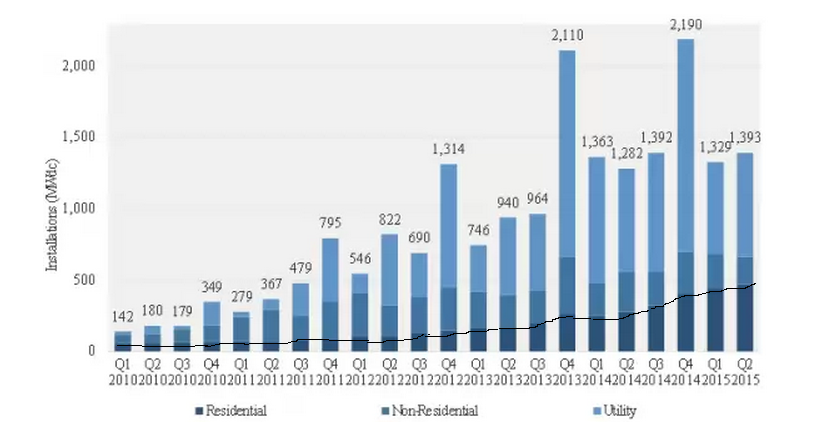
USA has witnessed a boom in its rooftop installations and a major portion of the credit will go to the ITC implementation. Incentives play a major part in boosting a particular technology. The federal incentives and regulations have always helped an industry mature, especially during the initial stage when the prices are high and not affordable by the general masses. Residential solar installations in USA increased by 6% in Q2’15 and 11% in Q1’15 on a quarterly basis. According to an infographic, the number of houses with rooftop solar is expected to reach 3.8 million by 2020, from just 30,000 homes in 2006.


(click to enlarge)


Source: GreenTechMedia


i) Impact on costs


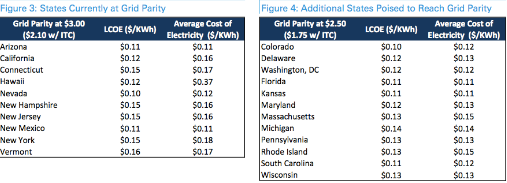
Almost half of the US states have already reached grid parity or are very close to attaining it. This means it makes more sense for them financially, to invest in a solar system than to be grid connected. The LCOE or Levelized cost of energy for solar system is almost equal to the electricity prices. Moreover, the solar costs are expected to fall by another 40% in the next couple of years.


Source: Community energy Inc


ii) Impact on demand growth


In terms of quantifying the impact of no state incentives, nearly 25% of the total residential solar installations came online without any state incentive in Q1 2015. The residential markets of California and Arizona continue to grow, even without any residential incentives. States like New York and Nevada are also showing a small growth in installations without the support of state incentives.


Source: SEIA


On the other hand, another analyst from Bloomberg said “With a proposed five-year federal ITC extension, we anticipate an additional 22 GW of solar will get built by 2022.” Though the residential solar will grow, the pace of growth will be slower.


iii) Impact on big Residential Installation Companies – The three big residential installers in USA are SolarCity (NASDAQ:SCTY), Vivint Solar (NYSE:VSLR) and Sunrun (NASDAQ:RUN). They have been successful in reducing their costs to a level that should help them see a smooth transition into the year 2017 even if ITC is not extended.


SolarCity is the biggest installer in the USA. The company in its recent Q2’15 earnings report mentioned that it would be able to maintain healthy unlevered IRRs of approximately 7.5% and an equity NPV of roughly $0.60 per watt, with 10% ITC in 2017.


Vivint Solar was successful in reducing its cost per watt to $3 in Q2’15, down from $3.21 in the first quarter of 2015 and $3.55 in the second quarter of 2014. The company too should remain competitive going into 2017. Sunrun’s cost is a little over Vivint Solar at $3.07 per watt but in my view Sunrun will be cost competitive as well.


Possibility of an ITC extension remains, as the Obama government is in favor of extending the ITC. Hilary Clinton also remains extremely pro-solar energy with her 500 million solar panels target however some Republicans are opposing it.


Downside Risks


It is a fact that the solar installations will face a slowdown in the year 2017 if solar installations no longer enjoy the tax credit. BNEF expects a drop of around 8 GW in the solar project pipeline, if the ITC is not extended. Another area of concern might be the Solar+storage. It is expensive to install solar plus storage compared to the grid prices. The storage industry is still in a nascent stage and would require financial subsidies to become popular. The ITC step down in 2016 will increase the costs particularly for solar and storage. This might dissuade people to install the solar storage component as it will still be expensive.


Conclusion


I am not totally ruling out the extension of ITC since some USA markets still depend upon federal incentives to make residential solar a viable option, but I believe a substantial section of market has already matured and will grow even if the ITC is not granted an extension. The prices of solar energy has fallen dramatically (more than 75%) in the last decade, when ITC came into being. Though I would vote in favor of the ITC getting an extension, I also think all good things have to come to an end. With the industry entering a mature state and major residential installers looking confident, the dominance of solar energy is inevitable in the long run. I would not worry about ITC not getting extended though it would help in a faster acceleration in solar energy adoptions.


The End Of Investment Tax Credit For Solar Energy Will Not The Kill Solar Industry

Tuesday, 30 December 2014

Macquarie Infrastructure lifts US Idaho wind farm investment

[unable to retrieve full-text content]


NEW York-listed Macquarie Infrastructure Group has lifted its holding in an Idaho wind farm development to 72.4 per cent, having bought an …


Macquarie Infrastructure lifts US Idaho wind farm investment

Sunday, 23 November 2014

European Investment Bank Agrees GBP 168 Million Backing for Lincs Offshore Transmission ...

Tomasz Wyszoamirski/iStock/Thinkstock


The European Investment Bank has agreed to provide GBP 168 million for a new connection between the Lincs offshore wind farm and the UK national transmission network. The approximately 100-km connection, between high voltage transmission connections on the mainland and the 270-MW Lincolnshire wind farm, has been tendered under a dedicated regulatory regime for offshore transmission networks by OFGEM, the UK gas and electricity market regulator.


“Offshore wind will play a significant role as part of the UK’s energy mix over the coming decades and the European Investment Bank is committed to supporting long-term investment in energy infrastructure that both enhances production of electricity from renewable sources and connects renewable energy into the national network. We are pleased to continue support for offshore wind infrastructure in UK waters and investment in transmission connections under the OFTO regime facilitates new investment in offshore wind farms. This sector is creating hundreds of new jobs along the North Sea coast and supporting manufacturing and research across the country.” said Jonathan Taylor, European Investment Bank Vice President.


The transmission connection to the Lincs wind farm, 8 km off the Skegness coast, will include one offshore substation and connect to the national transmission network at an onshore substation at Walpole, Norfolk. The Lincs wind farm will comprise 75 turbines that when operational can produce enough clean renewable energy for over 200,000 homes, equivalent to around two thirds of the homes in Lincolnshire and contribute to the UK government’s strategy of ensuring that 15% of energy is from renewable sources by 2020.


Assets for the Lincs offshore transmission connection have been developed by Lincs Wind Farm Limited, a joint venture between Centrica, Dong Energy and Siemens Project Ventures. Under the OFTO regime the transmission assets will be transferred to Transmission Capital Partners, a consortium comprising Amber Infrastructure, International Public Partnerships and Transmission Investment, who will own and operate the connection under a twenty year agreement.


This is the sixth connection under the OFTO regime, developed to ensure that offshore renewable generation projects are economically and efficiently connected to Britain’s electricity grid, to be supported by Europe’s long-term lending institution. Previous OFTO connections supported by the EIB include Walney 1 and 2, Sheringham Shoal, Greater Gabbard and London Array.


Last month the board of the EIB, comprising all 28 European member state shareholders, approved EIB’s participation in Round 3 of the OFTO regime.


European Investment Bank Agrees GBP 168 Million Backing for Lincs Offshore Transmission ...

Wednesday, 6 August 2014

Investment in solar energy space

Wed, 06 Aug 2014 05:52:47 GMT


Jinko Solar, a Chinese company listed on the New York stock exchange, has invested eighty million US dollars in a solar panel production plant in Cape Town to produce 120 megawatts per annum. South Africa’s department of trade and industry has allocated close to 1500 megawatts of solar projects as part of the independent power producers programme to reduce the country’s dependence on fossil fuels. Kevin James from GCX joins CNBC Africa for a look at investment in that space.


Investment in solar energy space