Nikola Tesla Secret
Showing posts with label Industry. Show all posts

Sunday, 6 March 2016

Solar Industry Surges

A recent report by the Solar Energy Industries Association (SEIA) states solar beat out natural gas capacity additions in 2015. It was the first time to happen, the report adds. Solar supplied 29.5 percent of all new electric generation capacity in the country. The total U.S. solar market experienced a growth rate of 17 percent in 2015 (business and residential).


States with pro-green energy legislators argue for initiatives such as rebates and tax breaks that make it easier for home and business owners to install solar panels on their roofs. Extension of net metering policies, which compensates users for solar electricity they don’t use at a higher retail rate, has also been an incentive for individuals to install rooftop solar systems.


U.S. corporations have increased their solar usage by 59 percent since 2014, SEIA states. In a survey by Enercore, with third-party marketing company Cobia Systems, the fastest-growing state for businesses interested in adding solar power systems to their business in 2016 was Massachusetts. Next up were New Mexico, Arizona, California, Colorado, Pennsylvania, Hawaii, North Carolina, New Jersey and Nevada.


Area businesses can announce relocations, new branches, changed ownership, events and honors from independent organizations by sending information to Times Record Business News, P.O. Box 1359, Fort Smith, AR 72902, or emailing biznews@swtimes.com.


Solar Industry Surges

Sunday, 28 February 2016

Wind power industry leaders to gather at Boston conference

BOSTON (AP) – Offshore wind power will be the focus of a gathering of business leaders and lawmakers in Boston this coming week.


The U.S. Offshore Wind Leadership Conference kicks off February 29 and runs through March 1 at the InterContinental Hotel in Boston.


U.S. Sen. Edward Markey, a Massachusetts Democrat, is the event’s keynote speaker.


Topics will include Europe’s experience with wind energy and the U.S.’s emerging industry in states like New Jersey, Maryland, Rhode Island and Massachusetts.


Deepwater Wind CEO Jeff Grybowski will talk about his company’s aim to build the nation’s first offshore wind farm.


The Providence-based company began work last July on a five-turbine farm off Block Island in Rhode Island. It also plans to build a farm of at least 200 turbines between Block Island and Martha’s Vineyard.


Wind power industry leaders to gather at Boston conference

Friday, 19 February 2016

Monday, 26 October 2015

The End Of Investment Tax Credit For Solar Energy Will Not The Kill Solar Industry


Summary


The ITC is expected to be stepped down in December 2016.


Solar industry is expected to grow with solar reaching grid parity in many US states.


Major residential players have successfully reduced their per watt cost and look confident to face the step down.


The Investment tax credit or ITC as it is commonly known, is regarded as the most generous federal incentives granted by the federal government for promotion of solar energy. It started in the year 2006 and is now due for step down in December 2016. According to this scheme, any residential or commercial establishment could claim a 30% tax credit from his tax bills for any rooftop installation which was installed before December 31, 2016. This tax credit will be reduced to nil or 10% depending upon the type of installation after December 2016, unless otherwise modified by the Congress. Though the federal tax credit played a very important role in boosting the solar installations in the USA, I believe the industry has now matured enough to carry on even if the ITC is not extended.


What is the Investment Tax Credit and its time span?


The investment tax credit enables the installer to claim a credit in the taxes he would pay. The ITC allows a 30% rebate for both commercial and residential installations placed in service before December 31, 2016. There is no doubt that the investment tax credit policy was started to boost the rooftop installations in USA. The 30% tax credit was first implemented for two years from 2006 till 2007, extended by a year’s time and thereafter had an eight-year extension. The ITC is set to drop from 30% to 10% for commercial systems and zero for residential systems by the end of 2016.


ITC enabled the rooftop solar to grow


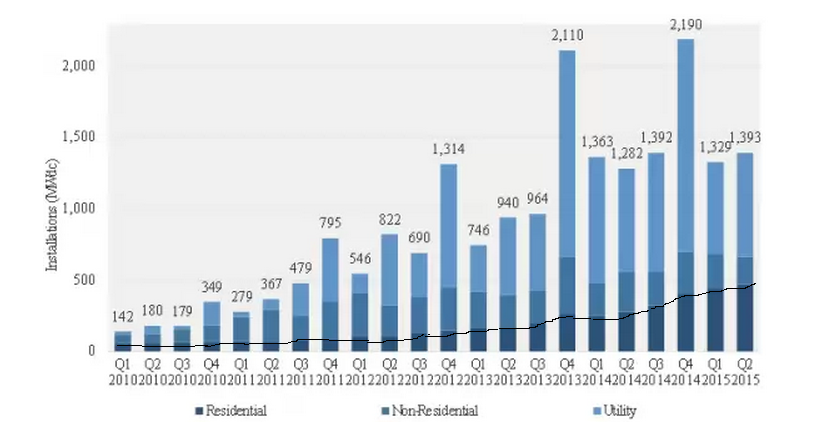
USA has witnessed a boom in its rooftop installations and a major portion of the credit will go to the ITC implementation. Incentives play a major part in boosting a particular technology. The federal incentives and regulations have always helped an industry mature, especially during the initial stage when the prices are high and not affordable by the general masses. Residential solar installations in USA increased by 6% in Q2’15 and 11% in Q1’15 on a quarterly basis. According to an infographic, the number of houses with rooftop solar is expected to reach 3.8 million by 2020, from just 30,000 homes in 2006.


(click to enlarge)


Source: GreenTechMedia


i) Impact on costs


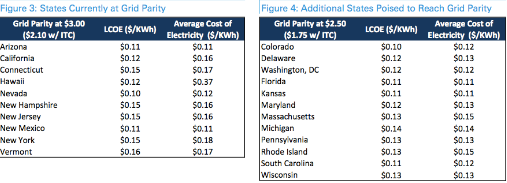
Almost half of the US states have already reached grid parity or are very close to attaining it. This means it makes more sense for them financially, to invest in a solar system than to be grid connected. The LCOE or Levelized cost of energy for solar system is almost equal to the electricity prices. Moreover, the solar costs are expected to fall by another 40% in the next couple of years.


Source: Community energy Inc


ii) Impact on demand growth


In terms of quantifying the impact of no state incentives, nearly 25% of the total residential solar installations came online without any state incentive in Q1 2015. The residential markets of California and Arizona continue to grow, even without any residential incentives. States like New York and Nevada are also showing a small growth in installations without the support of state incentives.


Source: SEIA


On the other hand, another analyst from Bloomberg said “With a proposed five-year federal ITC extension, we anticipate an additional 22 GW of solar will get built by 2022.” Though the residential solar will grow, the pace of growth will be slower.


iii) Impact on big Residential Installation Companies – The three big residential installers in USA are SolarCity (NASDAQ:SCTY), Vivint Solar (NYSE:VSLR) and Sunrun (NASDAQ:RUN). They have been successful in reducing their costs to a level that should help them see a smooth transition into the year 2017 even if ITC is not extended.


SolarCity is the biggest installer in the USA. The company in its recent Q2’15 earnings report mentioned that it would be able to maintain healthy unlevered IRRs of approximately 7.5% and an equity NPV of roughly $0.60 per watt, with 10% ITC in 2017.


Vivint Solar was successful in reducing its cost per watt to $3 in Q2’15, down from $3.21 in the first quarter of 2015 and $3.55 in the second quarter of 2014. The company too should remain competitive going into 2017. Sunrun’s cost is a little over Vivint Solar at $3.07 per watt but in my view Sunrun will be cost competitive as well.


Possibility of an ITC extension remains, as the Obama government is in favor of extending the ITC. Hilary Clinton also remains extremely pro-solar energy with her 500 million solar panels target however some Republicans are opposing it.


Downside Risks


It is a fact that the solar installations will face a slowdown in the year 2017 if solar installations no longer enjoy the tax credit. BNEF expects a drop of around 8 GW in the solar project pipeline, if the ITC is not extended. Another area of concern might be the Solar+storage. It is expensive to install solar plus storage compared to the grid prices. The storage industry is still in a nascent stage and would require financial subsidies to become popular. The ITC step down in 2016 will increase the costs particularly for solar and storage. This might dissuade people to install the solar storage component as it will still be expensive.


Conclusion


I am not totally ruling out the extension of ITC since some USA markets still depend upon federal incentives to make residential solar a viable option, but I believe a substantial section of market has already matured and will grow even if the ITC is not granted an extension. The prices of solar energy has fallen dramatically (more than 75%) in the last decade, when ITC came into being. Though I would vote in favor of the ITC getting an extension, I also think all good things have to come to an end. With the industry entering a mature state and major residential installers looking confident, the dominance of solar energy is inevitable in the long run. I would not worry about ITC not getting extended though it would help in a faster acceleration in solar energy adoptions.


The End Of Investment Tax Credit For Solar Energy Will Not The Kill Solar Industry

Friday, 24 July 2015

Solar Industry Shining Bright After Vivint-SunEdison Deal | Wall Street Daily


Solar Industry Shining Bright After Vivint-SunEdison Deal


The solar industry continues to shine both domestically and globally, despite falling prices for traditional fossil fuels.


Utah-based Vivint Solar, Inc. (VSLR) has grown quickly over the last few years and is now one of the largest U.S. residential solar installation companies. It has around 523 megawatts of contracted rooftop solar assets built or under development.


Vivint went public in late 2014, and has financed and installed over 40,000 solar panel systems as of the end of March 2015.


Before the Opening Bell this past Monday, Vivint’s stock surged on the announcement that it was being acquired by clean energy giant SunEdison, Inc. (SUNE) and its subsidiary, TerraForm Power.


Reaching For the Sun: Price of Vivint Solar Stock


SunEdison and TerraForm Power plan to pay $2.2 billion in a combination of cash and shares of SunEdison common stock and convertible notes.


The deal, which highlights how quickly the market is growing for rooftop solar panel systems, is expected to be a trifecta of success – a win for all parties.


Sharing the Light


For clean power giant SunEdison, the deal helps its expansion plans in the solar energy space both for residential and commercial buyers.


TerraForm Power is in the position to acquire actual solar projects from Vivint Solar, both the ones already built and projects in development. It can do so as the company is structured as a yieldco, meaning it’s a publicly traded company that bundles together the assets, in this case, of clean energy projects based around the long-term and predictable revenue generated by the reoccurring energy payments.


And, of course, Vivint and its shareholders are receiving $16.50 per share as part of the deal.


Ahmad Chatila, the CEO of SunEdison and Chairman of TerraForm Power, related that buying Vivint is part of the companies’ plan to become a major power provider.


“SunEdison’s acquisition of Vivint Solar is a logical next step in the transformation of our platform after the successful execution of our First Wind acquisition in January 2015,” said Chatila in a statement.


“[As] of the fourth quarter of 2015, our organic growth and recent acquisitions will put SunEdison on track to deploy more than 1 gigawatt per quarter,” he went on.


SunEdison also raised its 2016 annual guidance for production to between 4,200 and 4,500 megawatts – a 50% increase!


But SunEdison goes far beyond just energy production. The company has become a full-fledged financial services company, offering everything from asset management, to billing and reporting, to tax and audit services.


The Pioneer Outsourcer


SunEdison became a household name in the early 2000s as it was the first company to successfully introduce the “solar-as-a-service” model developed by the well-publicized entrepreneur Jigar Shah.


Shah’s model offered residential customers rooftops solar panel systems with little or no money down. The model generates income by charging customers a monthly energy bill, similar to any other utility.


Prior to the introduction of this model, solar customers were required to pay upfront for their solar panels, which, at that time, cost upwards of tens of thousands of dollars and can still be a hefty investment for today’s homeowners.


The model became such a success that in 2009, the large silicon wafer and solar module producer, MEMC Electronic Materials (an arm of Monsanto [MON]), acquired SunEdison, demonstrating how lucrative this new potential model could become. MEMC later decided to focus growing its business around clean energy. Thus, in recent years, it adopted the name of SunEdison.


Solar Sector Having Its “Day in the Shade”


Now, over a decade later, many solar companies have replicated this model to share the space with Vivint, including SolarCity Corp. (SCTY), the U.S. leader in both solar financing and installation, as well as privately held Clean Power Finance and Sunrun.


SunEdison also recently acquired a wind energy project in India, along with First Wind, one of the largest wind energy developers in the United States.


Plus, the U.S. solar panel industry broke records in the first quarter of 2015 in terms of the total number installed. The industry reached 437 megawatts of solar panels on home rooftops, a 76% increase from Q1 2014, according to the Solar Energy Industry Association.


Over the next five years, another three million new home rooftop solar systems are expected to be installed in the United States. The biggest companies are trying to expand vertically across the sector, structuring additional kinds of businesses in order to lower their costs.


In sum, this new acquisition reflects increased consolidation in a growing market. The bigger companies with deep pockets will continue to fight for rooftop space that can apply solar panels more effectively and economically than ever before.


The acquisition requires approval by Vivint stockholders and will face reporting requirements. But the deal is expected to close in the fourth quarter of 2015.


Good investing,


Shelley Goldberg


Shelley Goldberg is a global resources, commodities and environmental sustainability strategist with over 20 years of sector experience in energy, metals and mining, agriculture, and infrastructure. Learn More >>


Solar Industry Shining Bright After Vivint-SunEdison Deal | Wall Street Daily

Monday, 13 April 2015

Solar Energy Industry Association names new VP of finance and operations

The Solar Energy Industries Association (SEIA) recently named Mike Smith, a certified public accountant and certified association executive, vice president of finance and operations.


Smith is the former Chief of Staff and Senior Financial Officer for the Air Force Association, where he oversaw the organization’s operation and multi-million dollar budget. He has extensive experience working with nonprofit organizations, serving for years in lead roles at both a large telecommunications trade association and a federally-funded educational foundation. Smith is also no stranger to Washington D.C.  Before transitioning into nonprofit financial and organizational management, he spent more than eight years with a public accounting firm based in the nation’s capital.


“We are happy to welcome Mike into the SEIA family,” said Rhone Resch, SEIA president and CEO. “He has spent his career supporting and enhancing the operations of nonprofit organizations. I have no doubt that Mike will be a great addition to our team.”

Smith expressed excitement about joining the SEIA, which represents one of the fastest-growing industries in America. “I’m looking forward to working closely with SEIA’s talented staff, volunteers, executive leaders and members to do everything I can to support our mission and the U.S. solar energy industry,” he stated.


Solar Energy Industry Association names new VP of finance and operations

Wednesday, 20 August 2014

Australia freezes plans for A$20b renewable energy industry

Grocon CEO Daniel Grollo (right) shows off the roof of the Pixel building to US Ambassador to Australia Jeffrey Bleich (left), Australian Prime Minister Julia Gillard (2nd L) and US Secretary of State Hillary Clinton (second right) for an event on clean energy and green technology during a visit to the Australian city of Melbourne on November 7, 2010. — AFP picGrocon CEO Daniel Grollo (right) shows off the roof of the Pixel building to US Ambassador to Australia Jeffrey Bleich (left), Australian Prime Minister Julia Gillard (2nd L) and US Secretary of State Hillary Clinton (second right) for an event on clean energy and green technology during a visit to the Australian city of Melbourne on November 7, 2010. — AFP picCANBERRA, Aug 20 — Australia is frightening developers away from renewable energy even before the government decides whether to overhaul targets for the industry’s growth.


Prime Minister Tony Abbott’s decision to take advice on renewable energy targets from a skeptic about the causes of global warming prompted at least two developers to reconsider plans for wind and solar farms. Earlier this week, the company planning a giant solar plant in Mildura pulled out of the project citing the risk the government will rework its policy.


Concern that Australia will dismantle the target is unsettling an industry that has brought in A$20 billion (RM59 billion) since the country first set goals for clean energy in 2001. Abbott’s administration is working to limit electricity bills and has tilted Australia away from wind and solar power and toward the fossil fuels blamed for global warming.


“The reported intentions of Mr. Abbott amount to economic vandalism, pandering to the climate skeptic minority and represents a total misread of community aspirations,” said Miles George, managing director of Sydney-based Infigen Energy, which has stakes in 24 wind farms in Australia and the US.


Abbott named Dick Warburton in February to lead a review of the renewable energy policy and answer whether the nation should maintain targets for the technology. The former board member of the Reserve Bank of Australia told the Australian newspaper when he was appointed that he is a “skeptic that man-made carbon dioxide is creating global warming.”


Renewables spending


Australia’s spending on large-scale renewable energy projects fell to A$58 million in the six months through June from almost A$1.3 billion a year earlier, said Kobad Bhavnagri, head of research at Bloomberg New Energy Finance in Sydney.


Scrapping or significantly cutting Australia’s renewable energy target would be “catastrophic” for the industry, Chris Judd, chief executive officer of Suzlon Energy Ltd’s Senvion SE unit in Australia, said yesterday in a phone interview.


“If the government headed down that path and changed what is meant to be a stable, bipartisan supported policy platform, it creates red flags everywhere, not just for this sector,” Judd said.


Suzlon said yesterday it will reconsider investment in the A$1.5 billion Ceres wind farm in Australia if the policy is pared back. The day before, Solar Systems Pty suspended plans for a 100-megawatt photovoltaic plant in the state of Victoria. It would have used mirrors to focus the sun’s power on solar cells, one of the biggest projects of its kind in the world.


Bipartisan agreement


At Infigen, about 1,000 megawatts of projects won’t go ahead if the government scraps its target, George said in a phone interview from Sydney. Investors are troubled that Abbott would even attempt to roll back a bipartisan agreement, he said.


“There’s a lack of appreciation at the government level of the sovereign risk and investment value implications of a dramatic cut in the target,” George said. “It’s reckless.”


Warburton hasn’t made public statements about the policy he’ll recommend, and he couldn’t be reached for comment. Asked whether the government intends to scrap the renewable energy target, Treasurer Joe Hockey said yesterday that it will review Warburton’s report before deciding. Abbott’s office didn’t return calls seeking comment.


Keeping the renewables target would shrink coal’s share as the fuel for Australia’s power market from about 74 per cent to 64 per cent by 2020, according to the Climate Institute. Repealing it would add about US$8 billion in profit to coal plant operators including Origin Energy Ltd, AGL Energy Ltd and EnergyAustralia Holdings Ltd.


Electricity demand


“If the government changes the scheme and reduces the target, the consequences of that are obviously beneficial to those who own fossil-fuel assets,” AGL Managing Director Michael Fraser said today by phone. As the nation’s largest renewable energy developer, AGL could also be hurt, he said.


Fraser, whose company agreed earlier this year to buy two state-owned coal-fired power plants in New South Wales for A$1.51 billion, said the government needs to “rethink” the policy to spur significant investment in the industry.


EnergyAustralia, the Melbourne-based unit of CLP Holdings Ltd, may take in about US$2 billion more profit in the future on a present-value basis, the Climate Institute, an environmental research group, said in a report on Aug. 18.


20 per cent target


EnergyAustralia and other large utilities oppose the current requirement that Australia get 41,000 gigawatt hours of electricity from large-scale renewable projects by 2020. While the policy was originally designed to set Australia’s renewable share at 20 per cent, lower electricity demand means clean energy is poised to have an even larger share.


“EnergyAustralia does not support abolishing or closing the renewable energy target,” it said in a government submission in May. “Recalibration of the RET to equate to the original 20 per cent by 2020 policy commitment is the most balanced approach.” The company declined further comment.


The clean energy industry employs about 20,000 people and has brought in A$20 billion of investment since the government first approved a renewable energy target 13 years ago, according to the Clean Energy Council, which represents about 550 renewable developers.


Abbott already won approval from parliament to scrap a levy that 300 companies paid since 2012 for their emissions. That left Australia, the largest polluter per capita among industrial nations, without a system to cut greenhouse gases.


Clive Palmer


The prime minister has also sought to eliminate the Climate Change Authority, a government adviser, as well as the Clean Energy Finance Corp and the Australian Renewable Energy Agency, which provide funding for projects.


He would need support from lawmakers to scale back the target. Clive Palmer, the mining magnate who controls three critical seats in the upper house and helped Abbott repeal the carbon price, has said he’ll oppose abolishing the clean energy target. Even so, renewable developers are on the defensive.


“There’s been a lot of speculation whether the government will shut down the scheme altogether or cut the target substantially,” said Kane Thornton, acting CEO of the Clean Energy Council. “Investments have been made on the basis of the government’s policy remaining until 2030. If there are major changes, those investments will be damaged.”
— Bloomberg


Australia freezes plans for A$20b renewable energy industry

Friday, 28 March 2014

Power Electronics For Wind Turbines Market - Global Industry Analysis, Size, Share, Growth ...

Albany, New York, USA (PRWEB) March 28, 2014


The increase in consumption of the electrical energy by two percent per year has boosted the growth of the renewable sources. By 2060, around half of the world’s electrical energy is expected to come from wind turbines stations. Wind energy is now the world’s leading growing energy source. The continuous growth in the wind energy industry can be attributed to the research and development of innovative cost-reducing technologies and concerns to the environmental issues. Power electronics in the wind turbines contributes to the largest share of power electronics market. The change in the turbine architecture and convertors with an aim at greater efficiency and reducing operations and maintenance cost is contributing to the growth of this market.


Browse the full report with request TOC at http://www.transparencymarketresearch.com/power-electronics-wind-turbines.html.


With the need of lighter, cheaper and more efficient system, there are four technologies which are best suited for handling new system requirement such as silicon IGBT, Silicon Carbide (SiC)-based devices, Super Junction (SJ) MOSFETs, and Gallium Nitride (GaN). The major applications of power electronics in wind turbine are for adjustable (variable) speed motor drives, power generation plants, and power transmission & distribution systems. They are used in making power modules, stack assembly, power converter. Power electronics used in wind turbine include passive components such as laminated busbars, connectors, power capacitors, power resistors and wind convertor components such as stack, power module, IGBT stacks, IGBT, IGCT, and SiC.


The rising demand of the full convertor is driving the market forward. Innovations and technological up-gradation is one of the factors contributing to the growth of the market. Companies such as Infineon has introduced copper into the module, for die attach and connections and also introduction of the silver into power modules by Semikron is driving the market forward. Competitive environment and need of cost grades are some of the challenges faced by the new players who are trying to enter into the market. China is the largest market for this industry. The change in industry over the period of past five years has made China the leading contributor. Asia Pacific including China is having quicker growth and is expected to be the key market in the near future. European nations hold the second largest share in driving the market forward followed by EMEA and South America.


Some of the key participants in this market include ABB, AIST, AMSC, Enercon, Fairchild, Fuji Electric, GE Wind Energy, Mersen, Methode electronics, Semikron Elektronic GmbH & Co.KG, and Vestas.


This research report analyzes this market depending on its market segments, major geographies, and current market trends. Geographies analyzed under this research report include:
North America
Asia Pacific
Europe
Rest of the World


This report provides comprehensive analysis of:
Market growth drivers
Factors limiting market growth
Current market trends
Market structure
Market projections for upcoming years


This report is a complete study of current trends in the market, industry growth drivers, and restraints. It provides market projections for the coming years. It includes analysis of recent developments in technology, Porter’s five force model analysis and detailed profiles of top industry players. The report also includes a review of micro and macro factors essential for the existing market players and new entrants along with detailed value chain analysis.


Reasons for Buying this Report
This report provides pin-point analysis for changing competitive dynamics
It provides a forward looking perspective on different factors driving or restraining market growth
It provides a technological growth map over time to understand the industry growth rate
It provides a seven-year forecast assessed on the basis of how the market is predicted to grow
It helps in understanding the key product segments and their future
It provides pin point analysis of changing competition dynamics and keeps you ahead of competitors
It helps in making informed business decisions by having complete insights of market and by making in-depth analysis of market segments
It provides distinctive graphics and exemplified SWOT analysis of major market segments


Contact Us


Sheela AK
State Tower,
90 State Street,
Suite 700,
Albany NY – 12207
United States
Tel: +1-518-618-1030
Email: sales(at)transparencymarketresearch(dot)com


Browse Blog: http://technologyandmediaresearch.blogspot.co.uk/


Read the full story at http://www.prweb.com/releases/2014/03/prweb11714207.htm


This entry passed through the Full-Text RSS service — if this is your content and you’re reading it on someone else’s site, please read the FAQ at fivefilters.org/content-only/faq.php#publishers.


Power Electronics For Wind Turbines Market - Global Industry Analysis, Size, Share, Growth ...