Nikola Tesla Secret

Tuesday, 14 July 2015

Australia really cares about wind and solar energy – infographic

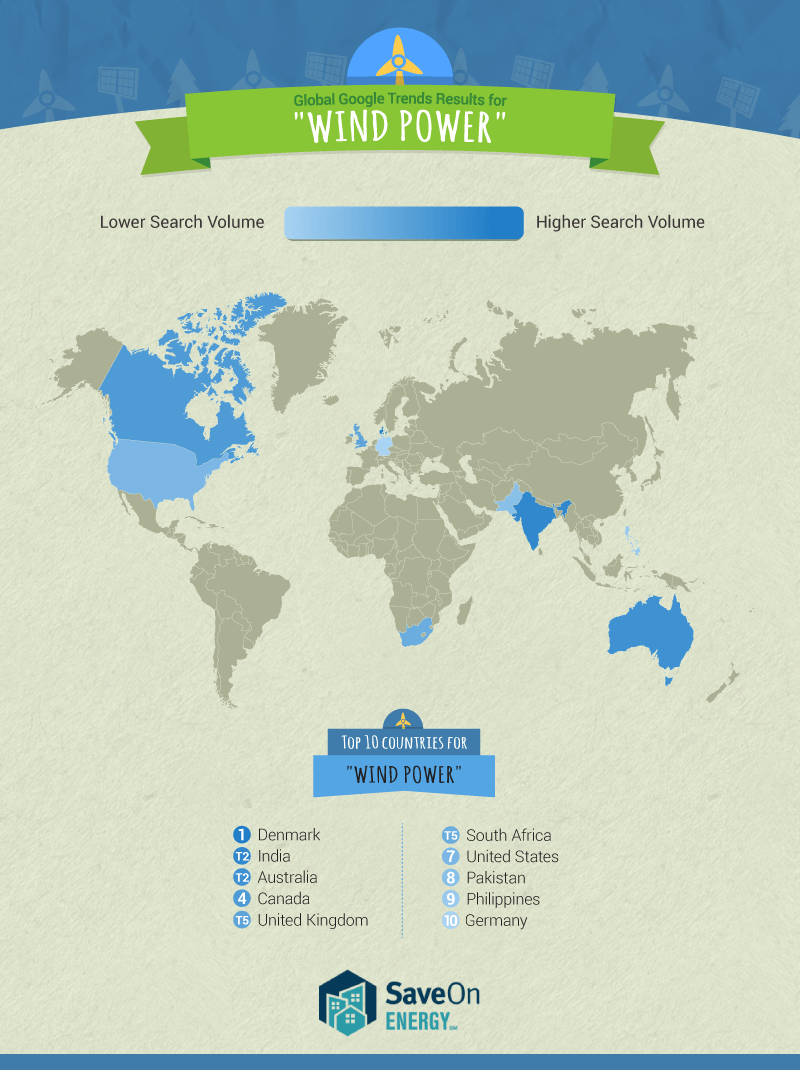
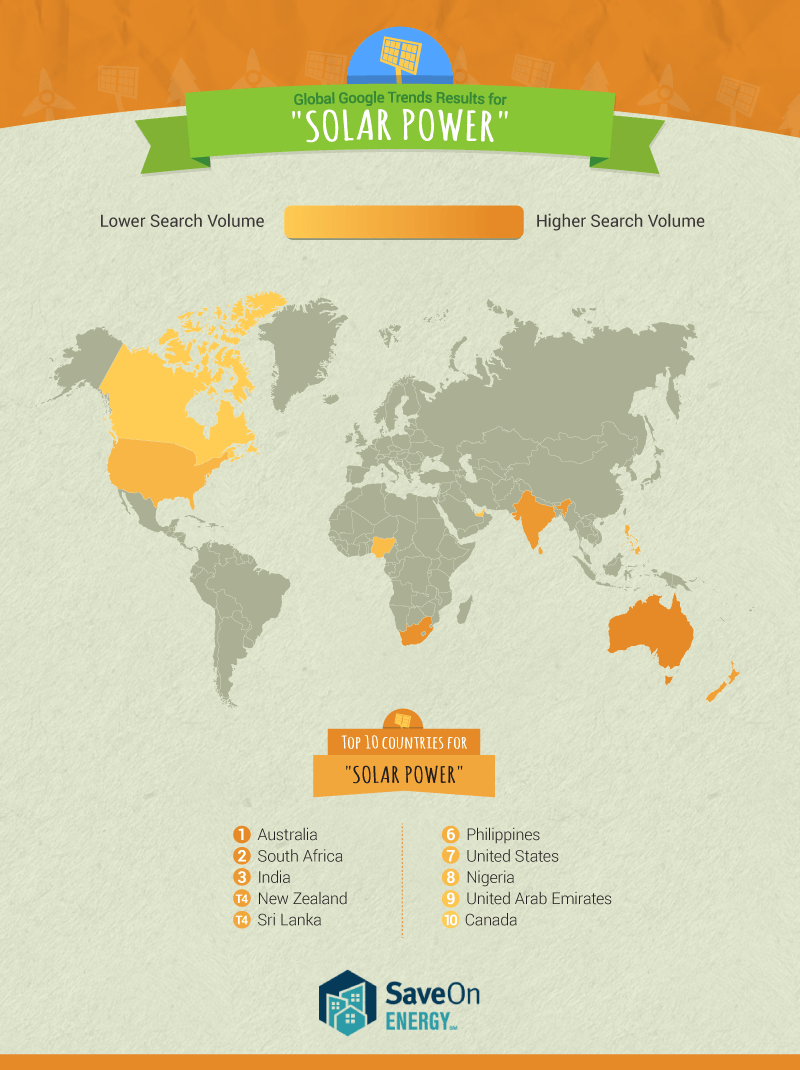
Have you ever wondered what countries spend the most time looking up things like wind energy and solar power? Well, thanks to this research, you no longer have to.


US company SaveOn Energy looked at Google trends to establish where most people looked up these topics, providing a good clue as to where it is part of the national psyche.


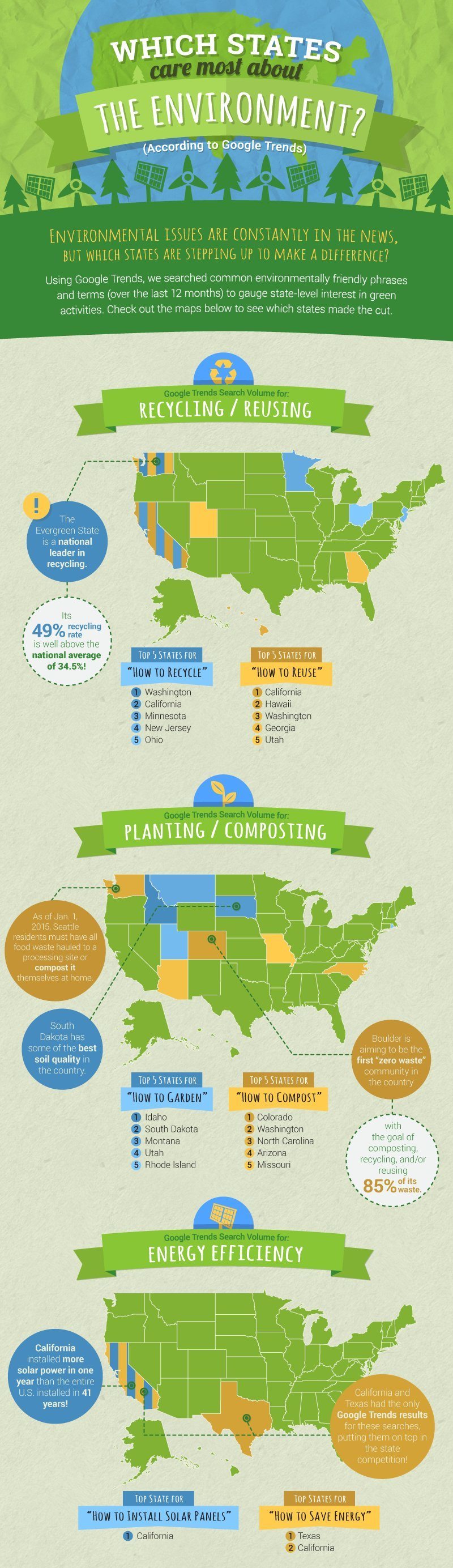
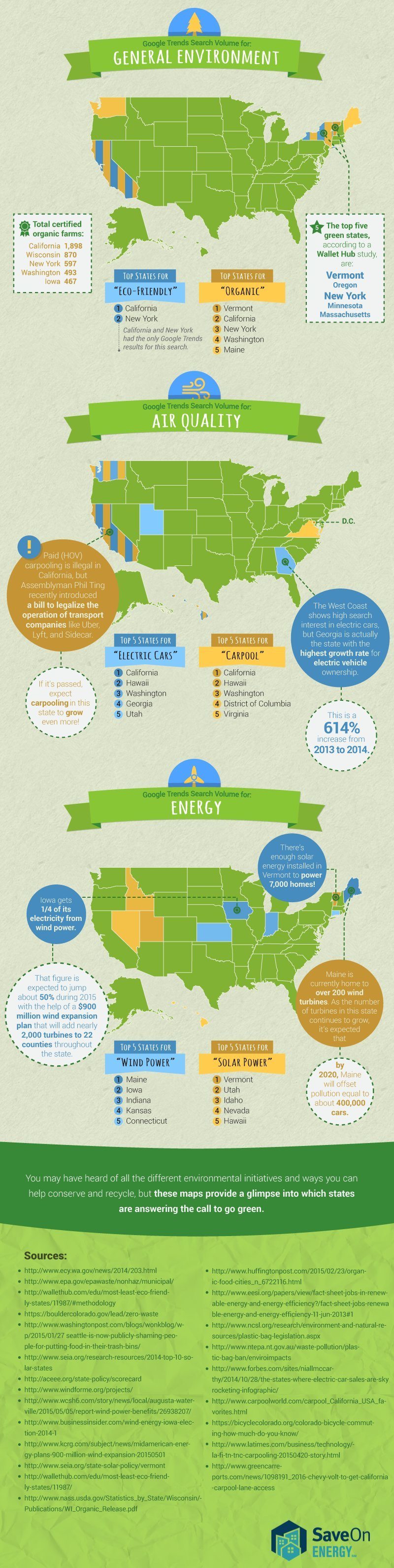
“We researched action phrases people may search for when looking into certain environmentally friendly activities,” says the company, “then we used Google Trends to rank the results by topic and state.”


On a global level Australia leads the way. The top ranked country to look up “solar power”, Australia also ranks second with regards “wind power”.


Naturally enough Europe is only prominent in the wind energy realm. It turns out the lack of sun greatly affects our thirst for solar energy.


Renewable energy global solar power search


In the US it turns out that California and Washington State are the places most likely to see people looking up “how to recycle” or “how to reuse”, with Idaho “how to garden” and Colorado “how to compost” emerging top of their class.


California installed more rooftop solar panels in 2013 than in the previous 30 years combined. Tellingly, it was the only state to see people looking up “how to install solar panels” in any great numbers.


Air quality is a concern for coastal states, with actual energy production – similar to farming and soil concerns – more prominent as you move inland.


P12 Renewable energy


renewable energy


Main image via Shutterstock


Australia really cares about wind and solar energy – infographic

Monday, 13 July 2015

'Fallout Shelter' news: First update for mobile game now live

Bethesda


“Fallout Shelter” is becoming a sensation, which is why Bethesda isn’t wasting any time in improving the mobile simulation game. Apart from much-needed changes, its first update introduces the new Photo Mode feature, which allows players to take a screenshot of their vault. 


To capture that special “Fallout Shelter” moment with those adorable vault dwellers, gamers simply need to tap the button at the bottom left corner of the screen. They can save the photo on the device or share it with their friends via their social media accounts. 


The update also fixes a bug that badger pregnant dwellers.


“Vault air filters have been causing some mothers to not deliver babies and we understand this is causing long term discomfort,” Bethesda said. 


With the update, all that’s taken care of. The game studio quipped that they can’t do much about the actual “discomfort [with] the baby coming out part.” Nevertheless, it’s good to know that pregnant dwellers will actually give birth this time. 


And lastly, the update should eliminate minor issues and bugs, which makes the game more stable now. Here is what Bethesda promises with the first ever update for “Fallout Shelter”:


  • Overseers are encouraged to record any bizarre dweller behavior with the new Photo Feature. Sharing with those outside your Vault is optional, and will not result in your replacement or termination.

  • Vault air filters have been causing some mothers to not deliver babies and we understand this is causing long term discomfort. We have solved this (not the discomfort, the baby coming out part).

  • We’ve also done general maintenance to improve sudden Vault shut down and removed some other pesky issues with the capacitors inside various aspects of the simulation.


Those who have yet to experience the free game can head over here and get started with building a state-of-the-art underground vault. 


"Fallout Shelter" news: First update for mobile game now live

Saturday, 11 July 2015

Wind Turbine Design and Testing

You will use this hands-on activity to help elementary students learn about the engineering process while exploring wind power. You will introduce students to the history of wind power and how it is used today to generate electricity. Students will work through the engineering process by designing, building, testing and modifying wind turbine blades. 


To prepare for your classroom visit, about two weeks in advance, review the information in the Engineer Guide and the materials provided for this activity. Contact the teacher and provide them with the list of materials you need the class to gather for the hands-on experiment. 


Wind Turbine Design and Testing

Friday, 10 July 2015

Keep cool and save on your power bill

<p>As summer sets in, a local utility is offering tips to help ensure the heat doesn’t get the best of your health or your wallet.</p><p>”Although summer officially started June 2l, people living in southeast Louisiana have already experienced temperatures in the low 90s with heat and humidity indexes reaching over 100 degrees,” said Joe Ticheli, manager of South Louisiana Electric Cooperative Association.</p><p>Based in Bayou Blue, the utility serves about 16,000 customers in Terrebonne, Lafourche, Assumption, St. Mary and St. Martin parishes.</p><p>Some tips:</p><p>Limit your activities: If you know you have work to do outdoors, plan it for the morning or evening, when the weather is cooler and the sun not so strong.</p><p>Keep cool: Dress in light, loose and comfortable clothing. Drink plenty of liquids. </p><p>Don’t add heat: Cook outdoors in late afternoons when possible, and bake as little as possible. Save washing, ironing and other hot chores until late evening or early morning. Use the microwave rather than the conventional oven. Take short showers and baths and use exhaust vents to remove moisture and humidity.</p><p>Fans can help: Use box, oscillating or ceiling fans to supplement or replace air-conditioning demands.</p><p>Air conditioning: Every degree you set your thermostat below 78 adds 3 percent more to the cost of cooling your home. Change air filters once a month. Have your air conditioning system checked and serviced regularly. If you don’t have air conditioning, go someplace that does.</p><p>Keep out the sun: Close curtains, blinds or shutters during the day to reduce sunlight invading your home. Strategically planted trees can be your best ally in this effort.</p><p>Other options: Do you have enough insulation in your attic? What about those leaky hot water faucets? Is the damper in the fireplace closed? How often do you unnecessarily open and close the refrigerator and freezer doors?</p><p>”The more energy you use the more it costs,” Ticheli said.</p><p>For more, call SLECA’s member services department at 876-6880.</p>


Keep cool and save on your power bill

Wednesday, 8 July 2015

German Green Power Forces Neighbors to Bolster Blackout Defenses


Germany’s drive to harness wind and solar power is producing so much electricity that it’s spilling over into neighbors’ grids and increasing the threat of blackouts.


Poland and the Czech Republic are spending $180 million on equipment to protect their systems from German power surges, while Austria is curbing some trading to prevent regional networks from collapsing. On a windy day, the overflow east can exceed the output from four atomic reactors.


Germany’s fivefold increase in green energy in the past decade has outpaced investment in power lines to move it across the country. Electricity is looping through Poland and the Czech Republic to reach southern Germany, where supply is constrained as Chancellor Angela Merkel shuts nuclear plants after the 2011 Fukushima disaster in Japan. The disruptions show the limits to the European Commission’s vision of a single power market.


“A huge accumulation of overflow increases the threat of a blackout,” Zbynek Boldis, the head of trade and international relations at Czech grid CEPS AS, said in an interview in Budapest. “The root of the situation is allowing a huge amount of electricity to be generated regardless of the capacity of the grid.”


Grid Upgrade


German grid companies plan to spend at least 22 billion euros ($24 billion) on high-voltage power lines as they upgrade their grids to accommodate more solar and wind power before the last of the eight remaining reactors close in 2022. Nine units generating almost 10 gigawatts — enough to power 20 million European homes — have been shuttered since 2011, with the latest on June 27. Nuclear power now accounts for 16 percent of Germany’s electricity, compared with 26 percent for renewables.


German power overflows are increasingly forcing Poland to protect its grid from overloading and triggering a blackout. The nation’s grid operator had to double the amount of last-minute changes to power-plant output to balance the surges in the first quarter from a year earlier.


On the windiest days, sometimes more than 50 percent of the power sent from northern Germany to its southern states and Austria travels through Poland and the Czech Republic, according to CEPS.


Surge Impact


Polish grid operator PSE SA says the surges take up so much of its import capacity that there’s not enough remaining for it to regularly carry lower-cost German power that could be made available to commercial users. German electricity for delivery next year is about 18 percent cheaper than Polish power, close to the widest gap since at least 2008, broker data show.


“My boss keeps asking why we aren’t buying power from Germany, but this is practically impossible,” said Henryk Kalis, the energy buyer for ZGH Boleslaw, a zinc processor controlled by ArcelorMittal. The Bukowno, Poland-based company pays more than $26 million a year for electricity.


The Poles and Czechs will by the end of next year finish installing transformers on two power lines connecting with Germany to control the unplanned flows and help free up capacity that can be traded or auctioned off to domestic customers.


While that will ease the pressure from overflows, the Polish and Czech grids still face congestion from the demand for cheap German power in Austria, which shares a wholesale electricity market with Germany.


Grid Congestion


For more than a decade, Austrian traders have bought German electricity when it’s cheap to sell to other countries at higher prices. This aggravates grid congestion as the amount traded has “significantly exceeded” the planned physical capacity between the countries, Jochen Homann, the president of German grid regulator Bundesnetzagentur in Bonn, said in a May interview.


Homann didn’t respond on Tuesday to multiple requests by phone and e-mail to the grid regulator’s office for additional comment.


Austria’s network operator is increasingly stopping traders from buying German same-day power, blocking purchases for 766 hourly periods in the first quarter, compared with 807 in all of 2014, grid data show.


Trading stops have “exploded since the fourth quarter, especially on the import side,” Manfred Knabl, head of trading at Verbund Trading GmbH in Vienna, said on July 3.


European Union lawmakers are preparing rules for an “energy union” for 2020, which aims to break down national barriers for power and gas flows, bolster energy security and reduce pollution. A draft outline will be unveiled July 15.


“We’re in an absurd situation,” Sigmar Gabriel, Germany’s economy minister, said at a utility conference in Berlin on June 24. “We produce cheap power in the north and can’t ship it south.”

German Green Power Forces Neighbors to Bolster Blackout Defenses

Tuesday, 7 July 2015

Obama works to expand solar energy for all Americans


President Barack Obama is continuing the push for more solar energy into the mainstream as the White House revealed a handful of initiatives to make the energy source accessible to lower-income households.


Solar may fall in price year after year, but the majority of panels in homes are skewed towards the upper-classes of America. According to a George Washington University Solar Institute report, of the roughly 645,000 homes in the U.S. that have installed solar panels, less than 5 percent are households making less than $40,000 per year (As reported by Mother Jones).


The current administration stated that the new solar initiatives are a part of its endeavor to address climate change, promote clean energy and creating good paying jobs. But in that, “we must also work to expand opportunities for families to use cleaner sources of energy that can help households save on their utility bills,” the administration said.


On Tuesday, the Obama administration detailed its plan to reduce this particular energy disparity. In the launching of the National Community Solar Partnership, a goal was set to unlock access to solar for the nearly 50 percent of households and business that are renters or do not have adequate roof space to install solar systems, including issuing a guide to developing community solar programs.


In addition, the press release announced the goal of installing 300 megawatts of renewable energy in federally subsidized housing. This is nearly triple the previous goal for 2020 set by President Obama. The White House stated that Housing authorities, rural electric co-ops, power companies, and organizations in more than 20 states across the country are committing to put in place more than 260 solar energy projects. This includes projects to help low and moderate income communities save on their energy bills and further community solar programs.


The White House noted that in 2014, the United States brought online as much solar energy every three weeks as it did in all of 2008, and the solar industry added jobs 10 times faster than the rest of the economy. Since the beginning of 2010, the average cost of a solar electric system has dropped by 50 percent.


In related news, Music artist Akon to open first-ever “Solar Academy” this summer.


Obama works to expand solar energy for all Americans

Monday, 6 July 2015

Are bridge-mounted wind turbines a viable option?

Wind turbines might be common sight all around the world, but situating them in open fields or on breezy ridges isn’t always a practical option. Ideas like placing turbines under bridges have been proposed, but is that a viable alternative? According to new research out of Europe, the answer is yes.


The study is based in models and computer simulations, which were carried out by researcher Oscar Soto and his colleagues in Kingston University (London)


The researchers from Spain and the UK, used the Juncal Viaduct in the Canary Islands as a basis for computer simulations designed to establish whether the wind blowing between the pillars on bridges is sufficient to move turbines and create energy.


The study showed that the best way to create power would be to use two different-sized turbines, or even to create a matrix of 24 small turbines because of their low weight and the amount of power that can be produced by each unit.


In terms of practicality, however, the study suggests that the best option would be to use two identical medium sized 0.25 MW turbines, which could theoretically generate enough energy to power 450-500 homes, as well as reduce CO2 emissions compared with fossil fuel sources.


“This kind of installation would avoid the emission of 140 tons of CO2 per year, an amount that represents the depuration effect of about 7,200 trees,” said researcher Oscar Soto.


A paper outlining the findings has been published in the journal Renewable and Sustainable Energy Reviews.


Source: Sinc


Are bridge-mounted wind turbines a viable option?